Getting married in Italy is a dream for many couples. For some, it means returning to their roots. For others, it means choosing a place that can turn the wedding into a wider experience, made of travel, beauty, hospitality and memory.
A destination wedding in Italy, however, does not begin with a beautiful venue alone. It begins with a precise project. Behind a sunset ceremony, a dinner beneath the stars, a carefully curated table and relaxed guests, there is always invisible work: organisation, vision, method and coordination.
The naturalness of the wedding day is never accidental. It is the result of choices made in advance, with care and clear direction.
Before the Venue Comes the Vision
Many couples start the planning process by searching for the venue. It is understandable: the place seems like the first concrete step, the one that makes everything feel real.
In truth, before the venue, there should be a deeper question: what kind of experience do we want to live, and offer to our guests?
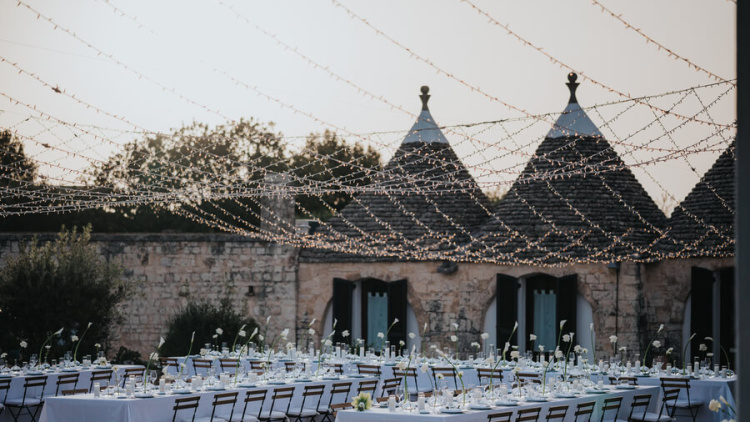
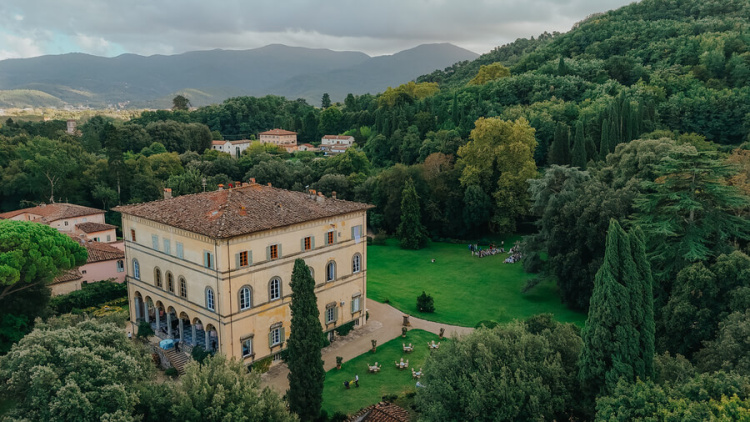
A wedding in Italy can take countless forms. It can be an elegant celebration in a historic villa, an intimate gathering in a masseria, an event among the Tuscan hills, a dinner overlooking the sea, a reception in an ancient village, or a weekend immersed in the countryside.
The choice of place should come from the couple’s character, not only from beautiful photographs. Some spaces are perfect for scenic weddings, others for more intimate celebrations. Some venues work well for international guests, while others require more complex logistics. There are wonderful places that may still not be coherent with the desired atmosphere.
This is why the first step is not booking. It is listening, interpreting and giving shape to a direction.
Planning a Wedding from Abroad Requires Method
When the couple lives far from Italy, every choice needs to be even more carefully ordered. Distance requires a clear process, with defined timing, correct priorities and constant communication.
A wedding in Italy for international couples requires attention to many aspects: site inspections, documents, suppliers, contracts, transfers, accommodation, hospitality, schedules, additional events, language management and different cultural habits.
None of this should become a burden for the couple. On the contrary, the design process exists precisely to turn complexity into a fluid journey.
The couple should feel accompanied, never overwhelmed. Each phase should come at the right moment: first the overall vision, then the venue selection, budget, key suppliers, aesthetic project, guest logistics, operational plan and finally the direction of the wedding day itself.
Method does not remove emotion. It protects it.
The Role of a Wedding Planner in a Destination Wedding
Relying on a destination wedding planner in Italy means choosing someone who can hold together two different dimensions: the creative side and the organisational one.
On one side there is the vision: colours, atmospheres, flowers, materials, lighting, music, table setting and the rhythm of the day. On the other, budget, deadlines, contracts, suppliers, logistics, technical timings, guests and unexpected issues.
A good project is born when these two dimensions are not treated separately. The aesthetic must be possible. The organisation must have soul.
The wedding planner therefore becomes a figure of direction. They interpret the couple’s wishes, build a coherent concept, select the most suitable professionals, coordinate every phase and protect the identity of the event down to the final detail.
On the wedding day, their work should almost disappear. Not because it is marginal, but because everything unfolds naturally. The couple should not have to control, check, ask or solve. They should live.
Budget: Not Only How Much to Spend, but Where to Create Value
The budget is one of the most delicate aspects of planning a destination wedding. It is often perceived as a limit, but in truth it is a design tool.
Setting a budget does not simply mean defining a figure. It means deciding where to invest, which elements hold the most value for the couple and which choices can be adjusted without weakening the overall experience.
Venue, catering, styling, floral design, photography, music, lighting, transfers, accommodation, welcome events, stationery, favours, technical staff: each item has a different impact.
An elegant wedding does not always come from multiplying elements. It comes from the ability to choose intelligently. Sometimes it is better to focus the budget on a few strong, coherent and well-executed details, rather than dispersing it across many solutions without direction.
True luxury is not excess. It is the feeling that everything is in the right place.
Choosing the Right Suppliers
In a destination wedding, suppliers are not simple executors. They are a living part of the project.
Photographer, floral designer, caterer, musicians, lighting designer, stationer, technicians, celebrant, make-up artist, hair stylist, rental company: every professional contributes to the final experience.
The selection must be careful. It is not enough to choose someone with a beautiful style or a strong reputation. It is necessary to understand whether that supplier is right for the venue, budget, type of event, tone of the couple and level of coordination required.
An excellent supplier in one context may not be the right one in another. The difference lies in the match.
This is why it is important to build a team that shares the same vision. When every professional works in the same direction, the wedding gains coherence. Guests do not see individual services. They perceive one atmosphere.
Hospitality: The Wedding Begins Before the Ceremony
For guests travelling from afar, the wedding is not limited to the day of the event. It begins with the journey, the arrival and the first contact with the place.
Accommodation, transfers, information, welcome dinner, possible activities, schedule management, guest assistance: everything contributes to the quality of the experience.
A well-designed destination wedding in Italy makes guests feel welcomed, not disoriented. Information must be clear. Transfers simple. Timings realistic. Experiences enjoyable, never forced.
A welcome dinner can create intimacy before the wedding. A brunch the following day can close the weekend gently. A tasting, a walk through a village, a moment by the sea or an evening in a masseria can reveal the region without turning the stay into a rigid programme.
The elegance of hospitality lies in balance: making every guest feel cared for, while still leaving them the pleasure of discovery.
The Aesthetic Project Must Speak to the Place
Italy offers settings that differ greatly from one another. The white light of Puglia is not the golden light of Tuscany. A masseria does not call for the same styling as a historic villa. A terrace by the sea has a different rhythm from an estate among vineyards.
This is why the aesthetic project must arise from the dialogue between the couple and the chosen place.
Colours, flowers, materials, furniture, lighting, table settings and graphic details should not appear added. They should belong to the environment, as though they had always been meant to be there.
This does not mean giving up the couple’s personality. Quite the opposite. It means translating it coherently, avoiding decorative choices that feel disconnected from the context.
A truly refined wedding does not chase trends. It may pass through them, when they serve the project, but it remains faithful to a deeper vision.
Seeing the Wedding Before It Exists
One of the most common fears during the planning process is not being able to imagine the final result.
Couples gather images, references, colours and suggestions. But between a moodboard and a real wedding, there is a significant distance. The proportions of the spaces, the table layout, the height of the installations, the relationship between flowers and architecture, the effect of light: everything changes when it enters the chosen venue.
This is why digital visualisation can become a decisive step.
Through renderings and representations of the spaces, the couple can see the project in advance: the ceremony, dinner, styling, details and atmospheres. Not simply inspiration, but a concrete form of the vision.
Seeing the wedding before it is created helps couples choose better, adjust sooner and trust more deeply. It allows them to arrive at the wedding day with a precious feeling: recognising what they are about to live.
The Timeline of the Day: Beauty Needs Rhythm
A wedding is not made only of places and details. It is made of timing.
The moment of the ceremony, the length of the aperitif, the beginning of dinner, the move into the party, the cake cutting, speeches, music and pauses: every choice affects the experience of both guests and couple.
A well-built timeline is not noticed. No one feels rushed, no one is left waiting too long, no important moment is sacrificed.
In a destination wedding, this aspect becomes even more important. Guests often do not know the place; they need to move, orient themselves and adapt to new rhythms. The day must be guided with discretion.
The direction of the event exists for this reason: to ensure that every step happens at the right moment, without visible rigidity.
The Backup Plan Is Not a Technical Detail
Every outdoor wedding needs a backup plan. Not as an emergency solution created at the last moment, but as an integral part of the project.
A well-designed backup plan should never feel like a compromise. It should preserve the same aesthetic level, the same care and the same atmosphere as the main project.
This applies to the ceremony, aperitif, dinner, music, guest routes and styling layout. Rain, wind, intense heat or sudden changes can be handled elegantly only if they have been considered in advance.
The couple’s serenity also comes from this: knowing the wedding has been designed for every possibility, leaving nothing to chance.
How to Experience the Planning Process with More Serenity
Planning a destination wedding can seem complex, especially when you live far from the chosen place. But complexity should not become confusion.
You need an ordered process. You need to know which decisions should be made straight away and which can wait. You need to avoid gathering inspiration without direction. You need to trust a guiding presence able to filter, propose, coordinate and protect the vision.
The couple should not arrive at the wedding exhausted by the organisation. They should arrive with their desire intact.
When the method works, every phase has meaning. Initial listening becomes concept. The concept becomes project. The project becomes experience. And the wedding day does not feel like the result of months of effort, but like something finally coming to life.
A Wedding in Italy That Truly Speaks of the Couple
Italy offers extraordinary places, but the destination alone is not enough.
A memorable wedding is born when the landscape meets a personal story. When the beauty of the place does not cover the couple’s identity, but accompanies it. When every detail — aesthetic, logistical, sensory — has a precise role.
The most successful destination wedding in Italy is not the one that looks perfect in photographs. It is the one the couple recognises as their own, from beginning to end.
To achieve that result, you need vision, method and care. You need someone who knows how to listen before proposing, design before organising, and coordinate without intruding.
In this way, the wedding stops being simply an event in Italy. It becomes an Italian experience in the deepest sense: made of places, time, hospitality, beauty and memory.
Would you like to understand how your destination wedding in Italy could take shape? Tell me your story: that is where the project can begin.